Self-Portrait Painting (Online Course)
Diana Buitrago
Tuesdays, 1 PM – 3 PM– please adjust for your timezones
January 12, 19, 26, February 2, 9, 16, 23, March 2, 2027
Plus over 10 hours of recorded demos. Access provided at least a week before each live class session. There is a homework assignment due the first class.
8 weeks- Tuition: $525
Limit: 10 students
Take this class:
- To solidify your understanding of the construction of a painting.
- To put into practice the fundamentals of GCA training by painting a human from life.
- To investigate the most personal subject matter.
Is this class for me/ prerequisite?
- Prior experience drawing in the academic method is highly recommended.
- Prior experience working with oil paint.
- Prior experience blocking in a portrait is helpful.
Class Format Notes:
- Pre-recorded demos distributed weekly. The first demo is distributed the week before the first live class. Homework is due on the first class.
- 2 hour live critiques class.
- Students work on their weekly assignment outside of class time.
- Every online class is recorded.
- Critiques are only given during the live class time.
- Attendance at every live class isn’t mandatory.
- Absentee students can still submit their work at least 15 minutes before the live class starts and the instructor will critique the work during the class. The critique will then be viewable in the recording.
- Students receive access to the class recording within 24 hours of the class finishing. The recording gets posted into the google classroom.
- Access to the recordings is available for the duration of the class plus an additional 30 days. There are no extensions.
Class Tech Needs:
- The critique portion of the class will be conducted on the Zoom platform and is a live online experience.
- The critique sessions are recorded and made available so students can review critiques after each live session for the entirety of the class.
- The demos are pre-recorded and shared via private links on YouTube. You will need a YouTube account to access the videos and share the email address associated with the account with Admin.
- This class also uses Google Classroom to share resources. Watch this video for more insight.
- All of these services/platforms are free but require registration.
- It will be necessary for students to have access to a computer, tablet or smartphone. The recommended device is a laptop or desktop for the live portion of the classes.
“Diana is a very encouraging teacher who helps you wherever you are. Her videos are incredibly insightful and full of information. She explained every step of her process with great detail and thought.”- Katie
Course Description
Painting a self-portrait in oil can be intimidating but it’s also a rite of passage. The act of self-investigation is a time honored tradition in art history. Instructor Diana Buitrago will teach the traditional process of painting from life using a mirror.
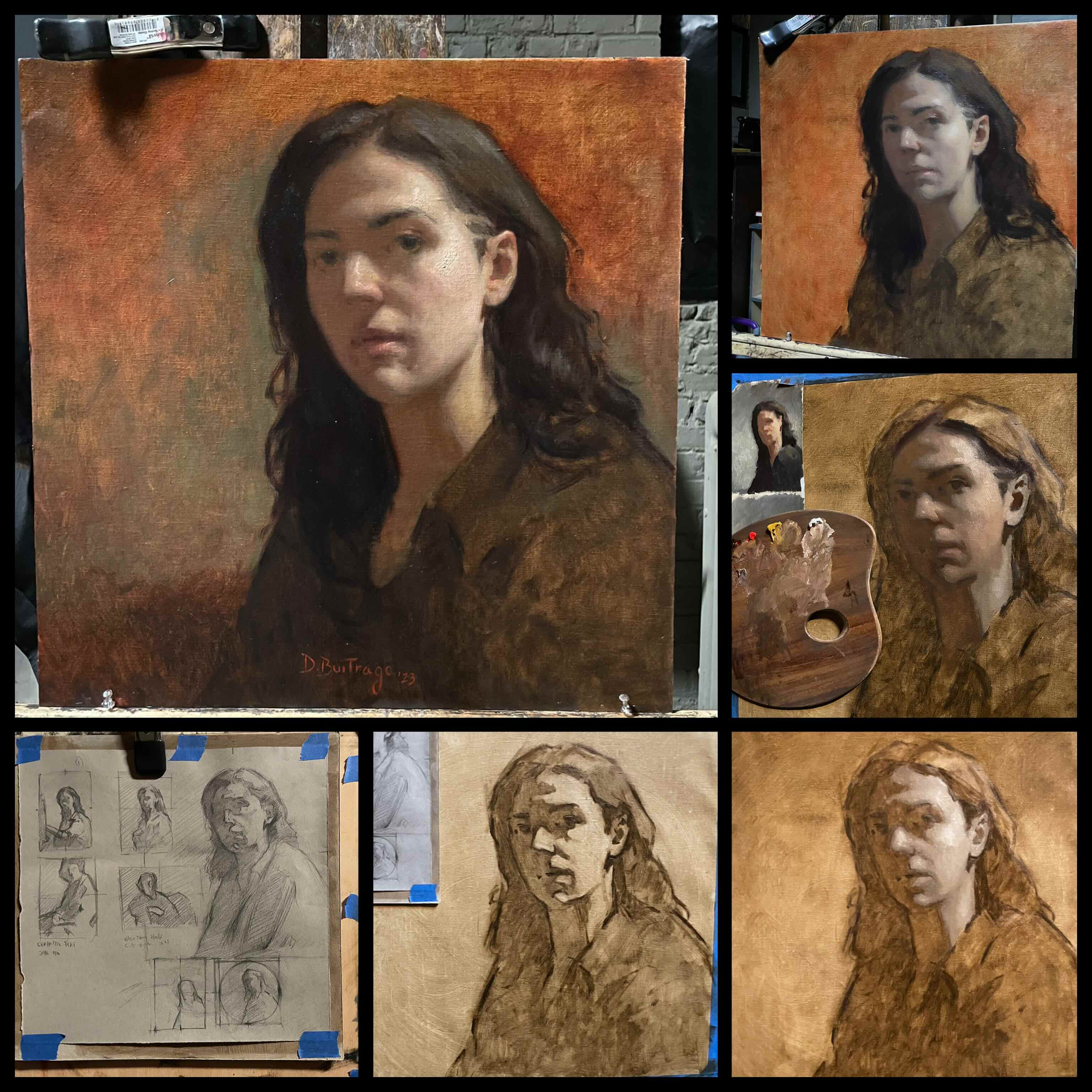
Over the course of eight weeks, Diana will guide artists through a step-by-step process using pre-recorded demos and presentations that will demystify each step as well as provide the class with lectures and images to complement the information. The painting process is broken down into weekly assignments including blocking-in the portrait, underpainting, color studies, and painting form in color.
Emphasizing the techniques used by the old masters, this class will utilize a limited palette (Apelles Palette) and a layered painting approach: Block-in, Underpainting, Form Pass and Revision Pass.
Students will submit images of their work each week for in-class critiques. For the sake of time and manageable goals, students will focus only on portraits of the head and neck. While some artists will finish their portraits, it is not a requirement and all are encouraged to work at their own pace according to their time and ability. The goal is to acquire new skills and to strengthen the application of techniques that will serve as a basis for the process.
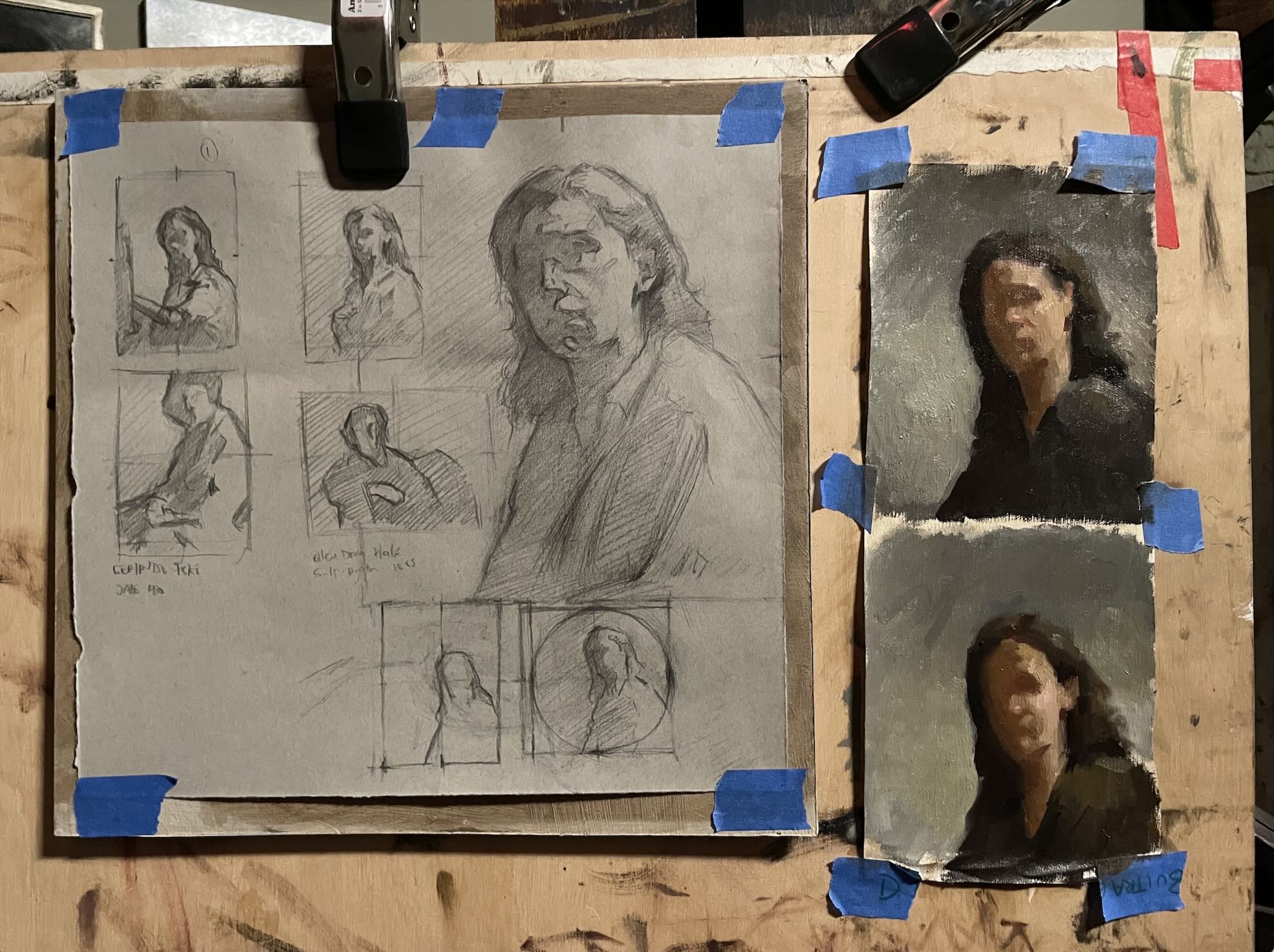
Assignments for each week are based on the topic of each session. For example, after watching Session 1, the assignment is to prepare your canvas, set-up your space, draw thumbnail sketches for compositions, submit images of all this process for the instructor on Google Classroom for critiques.
Session 1: Set up, Composition, Materials
- Introduction to the dynamic of the class.
- Quick presentation examining examples of old master self-portrait paintings.
- Set up using a mirror, controlling lighting.
- Materials review.
- Choosing, preparing, and toning the canvas.
- Small thumbnail compositions.
Session 2: Block-in – First Layer
- Block-in the portrait directly on the canvas using raw umber and a brush.
- Utilizing comparative measurements, shape finding, and point to point measurements to get the right proportion and likeness..
- Presentation on the main anatomical landmarks of the skull
Session 3: Color Study
- What is a color study and why is it important to do one?
- The properties of color based on the Munsell Color Theory
- Organizing the Apelles Palette*: White, Yellow Ochre, Cad Red Light, Black.
*Towards the end, on Session 7-8, the palette can be expanded with Lead Tin Yellow Light, Alizarin Crimson and Ultramarine Blue. Not necessary but optional.
Session 4: Underpainting (Grisaille Ébauche) – Second Layer:
- Presentation of underpainting examples from old masters to contemporary painters.
- Explanation of difference of Underpainting layer in grisaille and a grisaille itself.
- Underpainting Demo: a grisaille ébauche using Raw Umber + White.
Sessions 5 – 7: Rendering Light and Form – Third Layer/Form Pass
- Rendering form by form in color (working one area of the portrait at a time until completed)
- Lecture and demos on the concepts of light and form and the methodology of form by form rendering
Session 8: Glazing, Scumbling, Impasto and Finishing Accents: The Revision Pass
- Evaluating the revision steps.
- Applying the oily/ “over-layers” known as Glazing, Scumbling and Impasto.
- Techniques for scraping or sanding a surface that needs to be reworked.
- In this Session, the Form pass would be done, however, if the student needs another session to finish, this session should be used to finish the form pass and avoid worrying about the over-layers.
- If the student is done with the Form pass, this session serves as a revision pass to adjust any form issues, as well as to adding finishing accents, such as dark accents and higher lights.